The Bot Minders
As bots take on routine work, people will supervise their exceptions and managers will govern the people, authority and evidence around that supervision.
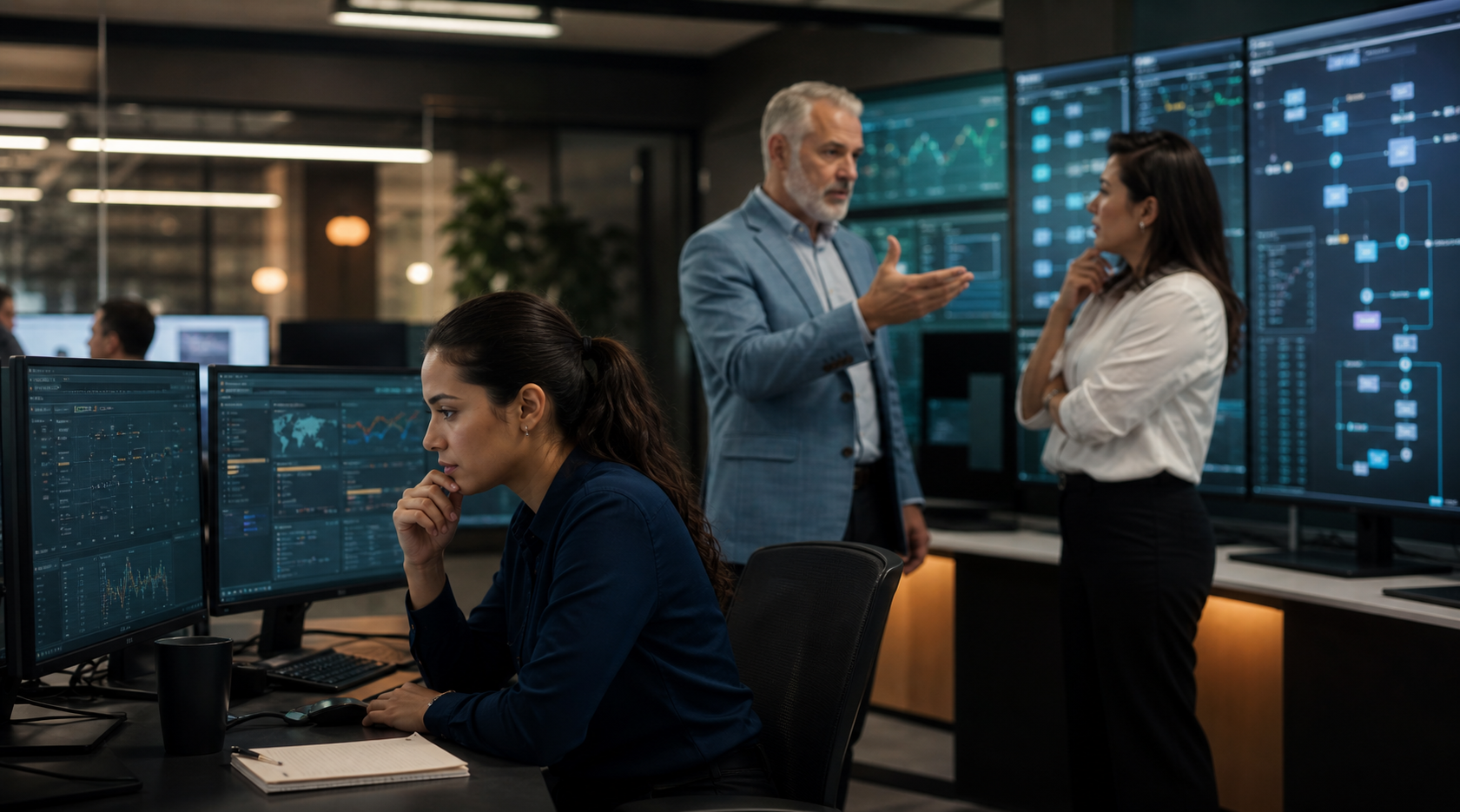
People Will Mind the Bots. Managers Will Mind the Bot Minders.
By Dr Riaan Steenberg
A customer asks for a refund. A bot reads the correspondence, checks the account, applies the policy, drafts the response and updates the case.
Most of the time, the answer is acceptable. Sometimes the policy was applied to the wrong product. Sometimes the customer's circumstances fall outside the normal rule. Sometimes the underlying record is incomplete. Sometimes the response is technically correct and commercially foolish.
A person watches the exceptions.
That person is not simply doing the old customer-service job with a new tool. They are supervising machine work. They inspect what the bot did, decide whether the evidence is sufficient, correct mistakes, handle unusual cases and identify patterns the system's designers did not anticipate.
They are a bot minder.
As organisations deploy more AI agents, many people will become bot minders whether or not the title appears on an organogram. Managers will then face a second-order job: they must manage the people who supervise the bots, and design the system in which human judgement and machine execution meet.
This is not a small change in productivity software. It is a new layer of organisational work.
The Work Moves From Production to Supervision
Automation rarely removes every part of a job at once. It changes the mix.
The routine cases move to the system. The unusual, consequential and ambiguous cases remain with people. A person who once processed twenty similar items may now monitor two hundred machine-processed items and intervene in the ten that require judgement.
This looks like an obvious productivity gain. It may be one. It also changes the nature of the human role.
The worker sees fewer normal cases and a higher concentration of difficult ones. They must understand the domain well enough to recognise when the bot's answer is wrong, even when it is fluent and plausible. They need authority to stop or override the process. They need a way to escalate uncertainty. They must convert recurring failures into improvements in rules, data, prompts, tools or workflow design.
The bot minder is part operator, reviewer, trainer, controller and investigator.
Calling this person a user of AI misses the point. They are responsible for the boundary between automated action and organisational judgement.
A Bot Minder Is Not a Prompt Engineer
The first wave of generative AI created excitement around prompt engineering. Better instructions produced better outputs, and organisations began teaching people how to ask machines for useful work.
Prompting remains useful. It is not the core of bot minding.
A bot minder needs to know what good work looks like before the bot produces it. They need to inspect sources, assumptions and exceptions. They must understand which errors are harmless, which are material and which reveal a systemic weakness. They need to recognise when the agent exceeded its authority even if the result happens to be correct.
The important skills include:
- domain judgement;
- evidence inspection;
- exception classification;
- risk awareness;
- quality control;
- escalation;
- process diagnosis;
- feedback design;
- accurate recording of interventions;
- knowing when the machine should not act.
These are management and professional skills applied at a new operating boundary.
The organisation that trains people only to prompt will produce faster interactions with bots. It will not necessarily produce safe or valuable machine work.
The Exception Load Changes Human Work
When bots take the routine work, people inherit the exception load.
This has consequences for job design.
Routine work is often boring, but it provides rhythm, recovery and context. A person who processes normal cases learns what normal looks like. If every item reaching the human is angry, ambiguous, high-value or already broken, the work becomes cognitively and emotionally dense.
The bot may reduce volume while increasing intensity.
Managers cannot measure the new job using the old unit count. Ten escalated cases may require more judgement than one hundred routine ones. A minder who pauses an automated process because the evidence is weak may have prevented harm, even though the dashboard records delay. A person who repeatedly corrects the same bot error is not underperforming; they may be exposing a design defect.
Productivity measures must change from transactions completed to interventions that protect or improve the system.
Useful measures might include error escape rate, exception resolution quality, unnecessary escalation, time to detect recurring failure, successful rollback, evidence completeness and the rate at which repeated interventions become permanent system improvements.
If management continues rewarding raw throughput, bot minders will be pushed to approve machine work faster than they can judge it.
Managers Become Minders of Minders
The manager's job is not to stand behind every bot minder and inspect every intervention. That simply moves the bottleneck up one level.
Managers must design the conditions under which bot minding works.
They define which decisions can be automated, which require human review and which cannot be delegated. They assign authority to pause, correct, approve or escalate. They decide how cases are sampled when full review is impossible. They set tolerances for error, cost, delay and consequence. They ensure that workers have enough domain exposure to recognise failure.
They also manage the human risks of the role.
Does the minder understand the standard? Are they becoming over-reliant on the bot? Are they overriding it reflexively because they do not trust it? Is the exception queue becoming unmanageable? Are people learning from interventions, or merely clearing alerts? Does the system surface disagreement, or does it make compliance with its recommendation easier than dissent?
The manager is responsible for the quality of the supervision system, not only the performance of individual supervisors.
Human in the Loop Is Not a Job Description
Organisations often describe a system as safe because it has a human in the loop.
The phrase conceals more than it explains.
Which human? At which point? Looking at what evidence? With how much time? Holding which authority? Accountable for which consequence?
A person who clicks approve on hundreds of machine decisions is technically in the loop. They may have no meaningful ability to evaluate them. A junior employee may see that something is wrong but lack authority to stop the process. A manager may be formally accountable but too distant from the work to understand how the system behaves.
Human presence is not human control.
A defensible control design must specify the intervention point, the information presented, the expected judgement, the available actions and the escalation path. It should also recognise that different kinds of bots need different supervision.
A drafting bot may require occasional sampling. A bot changing financial records may require reconciliation and approval. A bot making recommendations about admissions, employment or disciplinary action may require case-level human judgement and a record of reasons. A bot operating critical infrastructure needs enforced boundaries, monitoring and rapid shutdown.
The control should follow the consequence, not the novelty of the technology.
Bot Minders Need Protection From Automation Bias
A polished machine answer creates pressure to agree.
The bot responds quickly. It cites a rule. It produces a complete narrative. The human reviewer is busy and knows that most outputs are acceptable. Over time, review can become ritual approval.
This is automation bias: the tendency to accept the system's recommendation, especially when challenging it requires more effort than agreeing.
Good bot-minding design makes disagreement possible.
The minder should see the underlying evidence, not only the conclusion. The interface should expose uncertainty and missing information. High-risk decisions should require a reason, not a click. Samples of approved work should be checked after the fact. Known adversarial or unusual cases should be introduced to test whether people remain attentive.
Most importantly, the organisation should not punish correct intervention because it slowed the process.
If every override creates administrative pain, overrides will fall. If escalation is interpreted as incompetence, uncertainty will be hidden. If performance targets assume the bot is right, the human becomes decoration.
The Feedback Loop Must Lead Somewhere
A minder who corrects the same failure repeatedly is not part of a learning system. They are absorbing its defects.
Every intervention should have a route back into system improvement. The cause may sit in the model, the instructions, the data, the policy, the workflow or the way authority was assigned. The correction should be classified so that recurring patterns become visible.
This creates two operating loops.
The fast loop resolves the immediate case. The slow loop improves the system.
Without the fast loop, customers, employees or records may be harmed. Without the slow loop, the same harm keeps returning and the organisation quietly builds a permanent workforce around avoidable machine failure.
Managers of bot minders own the slow loop. They need regular forums in which intervention patterns are reviewed, changes are authorised, tests are run and the effect of those changes is measured. Technology teams cannot do this alone because many failures are not technical. They arise from ambiguous policy, poor data, conflicting objectives or unclear decision rights.
The Apprenticeship Problem Returns
Bot minding creates another problem: where will bot minders acquire the judgement needed to supervise the work?
If the machine handles most normal cases, new employees may not see enough of the underlying work to build pattern recognition. They may be asked to review a process they have never performed. The organisation removes the apprenticeship work and then expects junior people to exercise senior judgement over its automated replacement.
This is not sustainable.
Training must include deliberate exposure to normal cases, known failures, edge conditions and the reasons behind the standard. Simulations can help, but supervised live work remains important. New minders should earn broader authority through demonstrated competence. Their overrides and escalations should be reviewed as learning evidence, not only operational events.
Bot minding cannot become the place where inexperienced workers rubber-stamp machine decisions because they are cheaper than qualified reviewers.
A New Management Architecture
The organisation of machine work needs explicit roles.
At minimum, someone must own:
- the bot's mandate and permitted actions;
- the quality standard for its output;
- day-to-day exception handling;
- the authority to pause or override;
- monitoring and sampling;
- recurring-failure analysis;
- changes to prompts, rules, data or tools;
- the impact on customers, workers and regulated decisions;
- the evidence required to show that control is working.
These responsibilities may be distributed across operations, technology, risk, compliance and management. They should not be allowed to disappear between them.
The manager of bot minders becomes an integrator. They connect frontline evidence to system design. They protect the authority of the human reviewer. They decide when productivity is real and when it has merely moved hidden work into the exception queue. They ensure that a bot's capability is not mistaken for permission.
The Human Layer Does Not Disappear
The popular image of AI-driven work is an organisation with fewer people completing more tasks. That may happen. But the work removed from production often reappears as supervision, verification, exception handling, system improvement and governance.
The human layer changes position.
People move from producing every item to watching the quality of machine production. Some become bot minders. Managers become minders of those minders: designers of authority, workload, evidence and escalation.
This can produce better work. Machines can absorb repetition. People can focus on judgement, relationships and difficult cases. Failures can become visible across a system rather than remaining trapped in individual practice.
It can also produce a brittle organisation in which overworked people approve opaque machine decisions at speed.
The difference will not be determined by the intelligence of the bot. It will be determined by the quality of the management architecture around it.
Bots will do more work.
People will mind the bots.
Managers will have to make sure the minding is real.
Sources
Reading Map
Where to go next.
Follow the thread, jump to a fresh signal, or step into the deep archive. These are discovery paths through the body of work rather than claims about readership popularity.
Continue the thread
The nearest essays in the chronology, useful when you want to keep moving with the current line of thought.
Fresh signals
Recent essays from the archive for readers who want the newest edge of the map.
Deep archive
Older, less-travelled essays that deserve another pass through the reader’s hands.
Open another territory
Choose a larger field of inquiry when the current essay opens more than one door.