What Will Academia Look Like in 100 Years
By Riaan Steenberg May 2019 As we are discussing the characteristics of the emerging fourth industrial revolution, it seems that the future role of education…
By Riaan Steenberg
May 2019
As we are discussing the characteristics of the emerging fourth industrial revolution, it seems that the future role of education is remaining one of the imponderables.
If we start a thought experiment maybe we can transport ourselves 100 years from now and ask what does education look like then?
Will there still be journals that publish articles in a precise but obscure language that highlight statistical test against small samples to validate that one idea is better than another. If not — what will good academics do with their time?
Will you still go to lectures where the brightest minds share their revelations from twenty years of understanding the same question to learn a new way of looking at something? Or will you still go to those lecturers where you are told to read what is in the newest version of the textbook that is telling you a little more about what the authors did not know in the previous version, that was apparently the gospel until that point?
Let's evaluate for one second what we do know about the future world.
We know that government as a system will start failing as the collective governments of the world are bankrupt, and we are just waiting for the populace to foreclose. Taxes and entitlements are becoming an ever-larger proportion of normal earnings and at some time in the future people will organise themselves without any government has to be involved and people opting out of the apparent public benefit economy.
We know that we live in a time when that has the highest percentage of the population educated in formal institutions since the beginning of time, mainly due to the internet. We know that the student debt bubble must burst. We know that the education system will fall under the collapse of governments across the world.
At the same time, more people are waking up every day with a growing sense of human self-determination fueled by empowering technologies driven by ever-larger technology firms.
There is an increasing awareness that corporations are using money from people, and soon, the visibility of the daily operations of corporations will become not only a requirement but also a fundamental human right.
The breakdown of governments and the failure of public institutions then leads to a world of private education. Private education only works if there is a good balance between content production and content consumption.
At some point in time, someone is going to ask if the mainstay ideas of education are still relevant, and there will be very few experts that can answer the question. The virtualisation of education will open the age of the self-anointed professional (SAP) or MWP (Most Well-known Peanut) as the primary means of future education.
Strangely the whole world of education as we know it today will fade into historical obscurity where future generations will go onto their version of Wikipedia and look at how strangely people got educated in the 21st century.
At the same time, the MWP would not want to work for the Mega Corporation because they can be the personality (that will be one of the 20 billion other competing personalities) that knows the most about a specific topic and that can make their living off this.
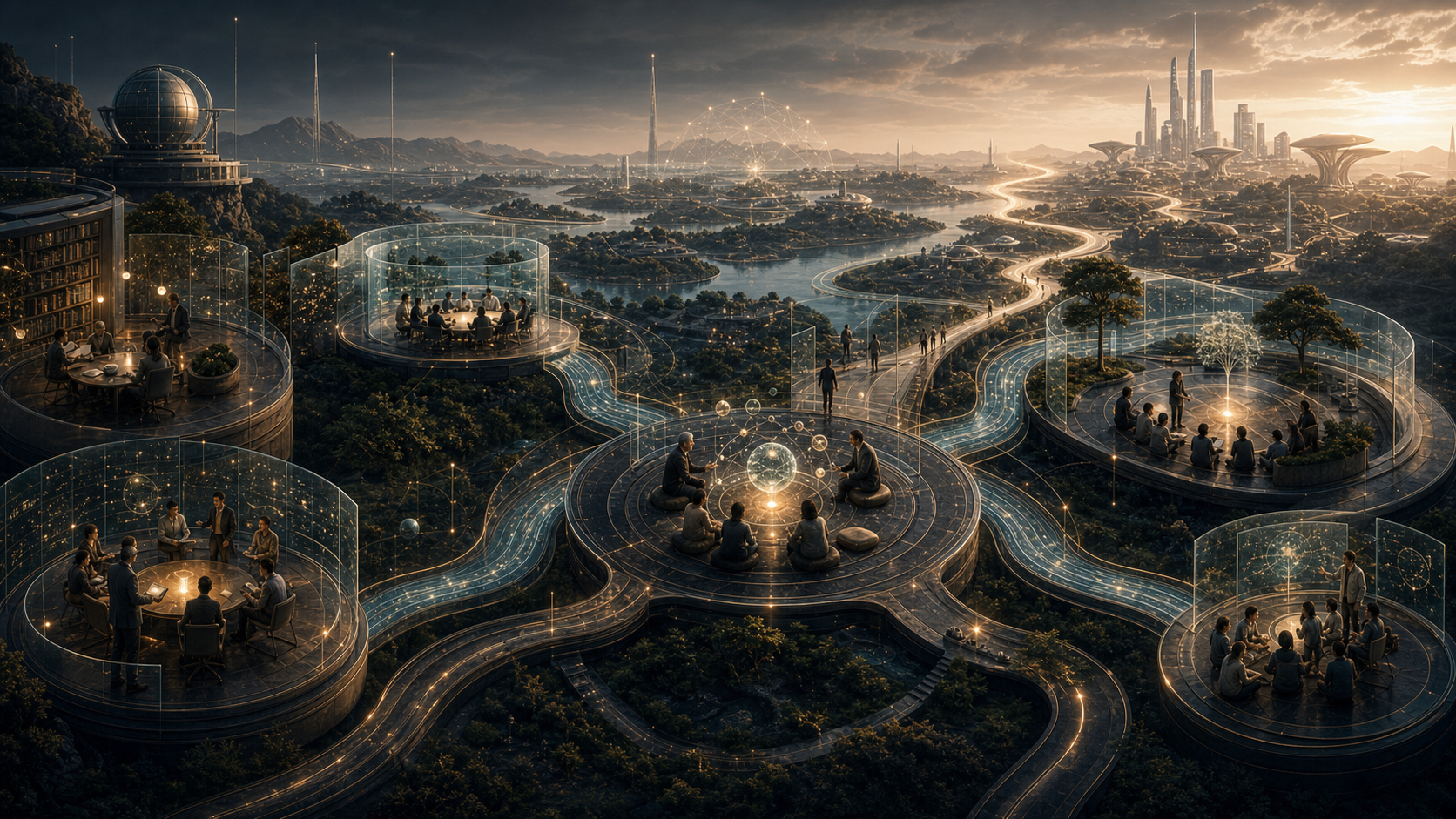
This will then lead to a world in which people with similar ideas form far looser combinations to attract more people into their constellation and where people that are oddly similar in their chosen are group together in Constellations.
Image a constellation of food growers, a constellation for people that build and maintain technologies, people that express in different ways and communities in which various aspects of the human condition is explored.
When you join one of these Constellations you will have access to cool things such as
Curated content and experience journeys
-
Cool resources that bring you up to speed on how to do the best things possible in that space.
-
Accelerated learning resources that would be micro items that would enable you to pick up specifics fast and learn the vocab, the ins and outs and ways that things work here.
-
Experience journeys that can accelerate your learning and teach you micro-skills in the shortest amount of time in a fun and engaging way.
Ageing content and discovery centres
-
There will come a time when we understand exactly how old an idea is and how relevant it remains now. One of the "tricks" of our current system of knowledge is that the more likes or views something has — the more legitimate it is. Algorithms have already started rewarding fresh ideas, alternative thinking and smaller, more niche content areas.
-
Image stepping into a discovery centre where streams that you are unfamiliar with invite you briefly you can see if this is interesting.
Massive online voting and goal-directed collective execution
- The future us one in which multiple rounds of voting on societal proposals will refine our sense and implementation of democracy. User-contributed changes will allow tens of thousands of people to simultaneously work on the plan for upgrading the local road or redesigning the sewer system. Bids and contracts will be negotiated in real-time and the micro contribution will go through block-chain to a central point that administers the agreed-on workflow without any thought of corruption or lack of work. You will be able to check-in on the works as it gets done (if it ever requires a human to be involved).
Supported learning and affirmation
- Support and affirmation will be everywhere. Right now, support is at a premium and companies make money monetising the input of others. Affirmation is something that you must pay someone to get. There will come a time when this all changes, and we all contribute something because of the huge gain that we get from others.
No project too large — no government required
- A lot of good and big ideas never see the light of day because they are too complex. In a future in which technology supports society to organise itself — any idea would be possible, democratically achievable and will be financed in more crowdsourced and transparent ways than ever before. What is public will truly be public and will have nothing to do with the current notion of a government. There will be complete traceability to see what happened to my contributions to any initiative.
Micro-micro payments everywhere
- The future is a world in which your life force is split into micropayment chunks and where the whole notion of money may not even exist. The competition is for attention and attention is also the reward. The ideas that gain attention get bigger and the ideas that do not, still appear, but they are given a chance to get more prominent over time. Ideas themselves become the currency and attract "funding" to live longer. Who organize this? Time will tell but probably some sort of world in which we work on an open-source, block-chain driven community that acts on collective instruction, assisted heavily by AI and robotic capabilities that are activated by a collectively agreed on "decision-making centre".
Management disappears
- Weirdly we have management to thank for what we have achieved in terms of progress, but also strangely — management has outlived its usefulness. Imagine a world in which we all live the Tim Ferris 4-hour work-week and we all contract with other contributors to achieve our goals. This world does not require managers, only good systems to track progress.
Linking education to product
-
Notice that when we started, there was no mention of an education system as in the future education is everywhere, assumed and the path from not knowing to know and doing is as close to real-time as is possible.
-
If in this world you do not know how to drive — then after a guided assisted tour, a virtual assistant tutor lesson and some subliminal messaging when you slept to embed safety behaviours, you are ready to press the button on that self-driving car and get to work on your own. The product itself will have the education that is required to consume the product and limit the liability of the collective that sold it to you.
Crowd legitimization and AI validation.
- We can already see that the only way in the future that something is legitimate is if the crowd makes it so and it is most likely that the role of AI would be to support decision making and act as the contracting agent to ensure the will of the people.
Verifiable experience journeys
- To know if you will be able to do a job — an AI will most likely review your experiences to date and propose the gap between where you are now and where you need to be to do a job and assign the job together with the required learning. There will be no more experts — only a society in which everyone contributes to the best of their ability.
De-corporatization of knowledge
- There will come a time in which the concept that a corporate or a collective can own the idea of another person will become impractical. Maybe we will have a better idea of the real utility of ideas and the barrier between what is inside and outside the organisation will become blurred. When idea ownership is provable, enforceable and rewardable by blockchain, then the point of asymmetry of ideas and ownership of the thinking power of another human being will become a ridiculous notion while society will put a high price on new ideas that can lead to utility in society.
A new world of work
- We know that more prosperous societies become smaller over time. Populations will start to shrink, and through advances in medical and other technologies, many people will have far more choice in how they manage their life expectancy. Work will become an increasingly smaller part of our daily lives and a larger part of our collective lives. Our work will enable others.
The education system has been premised on the evolution of a world in which experts knew, and others joined in increasingly sophisticated hierarchies of learning in smarter and smarter institutions to differentiate their value. Certification has become the currency as it was the only way to attest to the attainment. These ideas will fade as they become less relevant daily.
In a world 100 years from now — there will be a world of experts to draw from — each of us knowing a little bit and contributing that to an ever-growing melting pot of knowledge, experiences and resources that will open the doors to learning in a non-institutional way. Time and technology will verify our past, and every task will have its instructions in a bigger scheme that will depend less on information being kept from some and being only available to others.
Academia will be a time in your life when you are intellectually active, rigorous and meticulous in curating your knowledge, but your path for getting to this point will be a self-defined journey, with pointers from an expert community of people that have gone through this process. During this time, your objectives will be to give back and to contribute to the well-being of others, not through regurgitating what has happened before in a hope to advance the knowledge of humanity — but to solve the future imponderables.
Education will certainly change. The way that it changes in time will be profound and will alter the very fabric of society. Our current education system is unfortunately not preparing us for this future yet, maybe because it is unable to, and one can only hope that nostalgia of a system that has mostly been designed to bridge distance can make way for a system that exists in a world of open information.
Bibliography
Andaleeb, S. S. (2016). Reimagining academia for students of the future.
Bosanquet, A., Mailey, A., Matthews, K. E., & Lodge, J. M. (2017). Redefining 'early career'in academia: a collective narrative approach. Higher Education Research & Development, 36(5), 890-902.
Chen, A. H., Pickle, S., & Waldroup, H. L. (2015). Changing and expanding libraries: Exhibitions, institutional repositories, and the future of academia.
Dwelle, T. L., Halverson, P. K., & Petersen, D. J. (2015). Not so strange bedfellows: How practice and academia together will ensure the future of the public health workforce. Journal of Public Health Management and Practice, 21, S11-S12.
Huber, B. (2016). The future of Universities—academic freedom, the autonomy of Universities and competition in academia revisited. University priorities and constraints.
Powell, K. (2015). The future of the postdoc. Nature News, 520(7546), 144.
Schneider, A. K. (2017). Entrepreneurial Literary Theory: A Debate on Research and the Future of Academia. American, British and Canadian Studies, (2), 209-212.
Sobol, H. (1990). Future directions in engineering education: A view from industry and academia. IEEE Communications Magazine, 28(12), 25-29.
Reading Map
Where to go next.
Follow the thread, jump to a fresh signal, or step into the deep archive. These are discovery paths through the body of work rather than claims about readership popularity.
Continue the thread
The nearest essays in the chronology, useful when you want to keep moving with the current line of thought.
Fresh signals
Recent essays from the archive for readers who want the newest edge of the map.
Deep archive
Older, less-travelled essays that deserve another pass through the reader’s hands.
Open another territory
Choose a larger field of inquiry when the current essay opens more than one door.