Customize Your Education – One Qualification at a Time
The idea that ever person on earth is unique is surprisingly new. Before Crick and Watson discovered DNA – the world was convinced that we are all the same…
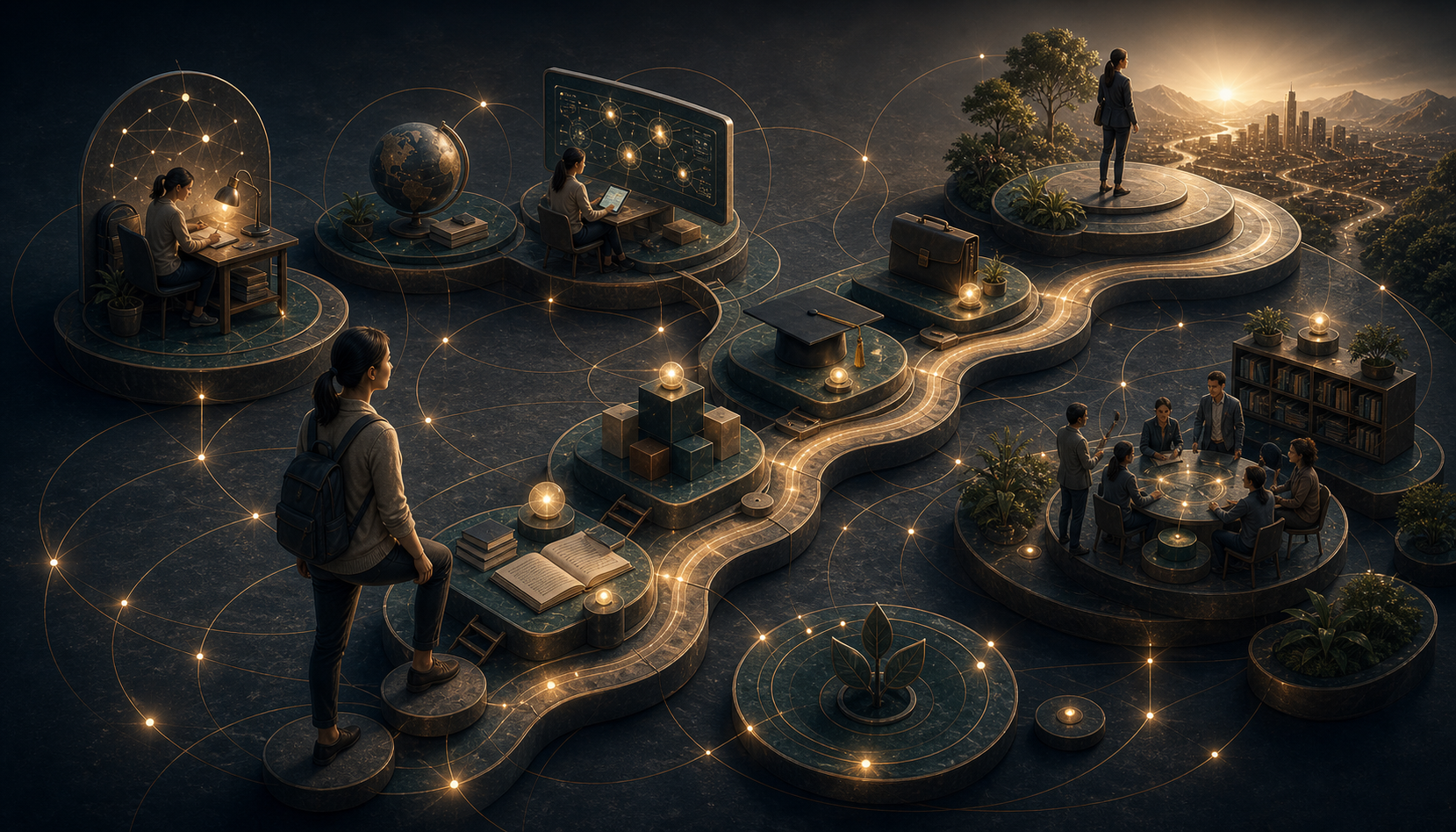
The idea that every person on earth is unique is surprisingly
recent.
Before modern genetics, it was easy to imagine that people were
broadly the same and that difference was mostly a matter of upbringing,
class, language or culture. We now know that even at a biological level
the combinations are almost endless. Add life experience, family
context, personality, ambition, trauma, opportunity, geography, work
history and personal choice, and the idea of a standard human being
becomes absurd.
Yet education has often been built as if standard people exist.
We create standard courses, standard pathways, standard timetables,
standard assessments and standard career assumptions. We ask learners to
fit the system rather than asking how the system can help different
people build capability in different ways.
This is changing.
The power of the individual is returning to the centre of education.
People no longer need to accept that one qualification, one institution,
one career path or one moment in life should define their entire future.
Education can become more personal, more modular and more directly
connected to the life a person is trying to build.
The challenge is to customise education without making it
shallow.
The Problem with
One-Size-Fits-All Education
One-size-fits-all education is administratively convenient.
It is easier to timetable. Easier to price. Easier to regulate.
Easier to explain. Easier to compare. It allows institutions to process
large numbers of learners through a common structure.
But convenience is not the same as effectiveness.
A young school leaver, a working parent, a mid-career manager, an
entrepreneur, a technical specialist and a person returning to study
after failure do not need exactly the same educational experience. They
may need the same standard of quality, but not the same path.
Some learners need confidence. Some need technical depth. Some need a
formal qualification to unlock a career gate. Some need short bursts of
practical learning. Some need time to think. Some need coaching. Some
need flexibility because life will not pause while they study.
If education treats all of them as the same, it wastes potential.
The question is not whether standards should fall. They should not.
The question is whether the route to competence can become more
intelligent.
Qualifications as Building
Blocks
A qualification should not be seen only as a certificate at the end
of a course.
It should be seen as a building block in a larger life
architecture.
One person may begin with a short course because they need immediate
confidence. Another may need a diploma to enter a field. Another may
need a degree to build depth. Another may need a postgraduate
qualification to shift from operational work into leadership. Another
may need a professional certificate to stay current in a changing
industry.
Each step can matter.
Education becomes powerful when qualifications connect to one
another. A short learning experience should help a person decide whether
a field is right for them. A certificate should open a path to deeper
study. A diploma should not be a dead end. A degree should not be the
end of learning. A postgraduate programme should connect thought to
practice.
The best education pathways allow people to move forward without
pretending that everyone must start in the same place.
This is what it means to customise education one qualification at a
time.
The Individual as the
Unit of Development
Companies increasingly realise that employees are not
interchangeable.
At the height of the process revolution it was tempting to believe
that people could be replaced by another person with the same job title.
If one sales person left, another sales person could be added. If one
administrator left, another administrator could be trained. The system
mattered more than the individual.
Systems still matter. But the individual matters more than many
organisations admitted.
People bring judgement, relationships, creativity, trust, customer
knowledge, technical intuition and emotional energy. Two people with the
same qualification can produce very different results. Two people with
the same job description can create very different futures.
This makes the work of education and HR more interesting.
It also makes it more demanding.
Development can no longer be treated only as sending people on
generic courses. The real question is: what is this person capable of
becoming, and what learning pathway will help them get there?
This requires conversation, assessment, feedback and imagination. It
requires a view of the person beyond the current role.
Education Across a Lifetime
The old model of education was front-loaded.
You studied when you were young. You qualified. You worked. Perhaps
you returned to study if promotion required it, but the main educational
event happened early in life.
That model is no longer enough.
Industries change too quickly. Technology changes too quickly.
Organisations restructure. Careers bend. People live longer. Skills
expire. New opportunities appear in fields that did not exist when a
person first studied.
Education must therefore become a lifelong pattern.
This does not mean everyone must always be formally enrolled in
something. It means that learning becomes part of how a person manages
their own life. Sometimes the right learning is a qualification.
Sometimes it is mentoring. Sometimes it is a short course. Sometimes it
is a project. Sometimes it is reading, reflection, teaching, coaching or
deliberate practice.
The important point is that the person remains in motion.
One qualification at a time. One skill at a time. One shift in
identity at a time.
Customisation Requires
Responsibility
Customised education should not become random education.
There is a danger that people collect disconnected certificates
without a coherent plan. They attend courses because they are
fashionable, cheap, convenient or impressive. They learn many things but
do not build a direction.
Freedom requires responsibility.
The learner must ask: What am I trying to become? What capability do
I need next? What qualification will create real leverage? What is the
difference between curiosity and priority? What evidence will show that
I have grown?
Institutions also have responsibility.
They should not simply sell more courses. They should help learners
understand pathways. They should show how different qualifications
connect. They should explain prerequisites, outcomes and realistic
career implications. They should be honest about what a course can and
cannot do.
Employers have responsibility too.
They should stop treating development as a reward only for a few high
performers. Learning is part of organisational resilience. A company
that does not develop its people eventually has to buy capability from
outside, often at greater cost and with less cultural fit.
Customisation works best when learner, institution and employer all
take development seriously.
The Role of Technology
Technology makes customised education more possible.
Online learning, learning platforms, digital assessments, recorded
lectures, adaptive tools, simulations and remote collaboration allow
education to reach people who could not always attend traditional
classrooms.
But technology is only useful when it serves learning.
A platform does not create wisdom by itself. A video does not
guarantee understanding. A quiz does not prove competence. Technology
can widen access, but it must be paired with good design, meaningful
assessment, feedback, support and human connection.
The great opportunity is not merely to put old education online.
The opportunity is to create learning pathways that are flexible,
trackable and personal without losing depth. A learner should be able to
build a portfolio of capability over time. They should be able to move
between work and study. They should be able to prove what they know, not
only display what they attended.
Technology should help people take ownership of their
development.
Designing a Personal
Learning Path
A useful learning path starts with honest diagnosis.
Where am I now? What do I know? What do I avoid? What work gives me
energy? What opportunities am I not yet ready for? What qualification
would open the next gate? What skill would make my current work
stronger?
From there, the path can be built in layers.
First, build foundation. This may be literacy, numeracy, digital
confidence, communication, financial understanding or a basic technical
qualification.
Second, build competence. This is the ability to perform real work in
a field.
Third, build judgement. This is the ability to decide, prioritise,
solve problems and understand consequences.
Fourth, build leadership. This is the ability to help others perform,
learn and grow.
Fifth, build renewal. This is the ability to keep learning as the
world changes.
Not every person will follow the same sequence. But every person
benefits from knowing which layer they are building.
Conclusion
Education should not force unique people into identical pathways.
The purpose of education is not only to certify that someone
completed a programme. It is to help people become more capable, more
thoughtful, more useful and more able to shape their own future.
Customising education one qualification at a time is not about
lowering standards or making learning casual. It is about recognising
that people begin from different places, carry different
responsibilities, and move towards different versions of
contribution.
The future of education will belong to institutions that can combine
rigour with flexibility, structure with choice, and qualifications with
real capability.
The future will also belong to learners who take responsibility for
their own development.
One qualification may open a door.
Another may deepen a craft.
Another may change a career.
Another may help a person become who they were already capable of
becoming.
That is the promise of customised education: not education made
smaller for the individual, but education made more powerful because it
finally sees the individual.
Reading Map
Where to go next.
Follow the thread, jump to a fresh signal, or step into the deep archive. These are discovery paths through the body of work rather than claims about readership popularity.
Continue the thread
The nearest essays in the chronology, useful when you want to keep moving with the current line of thought.
Fresh signals
Recent essays from the archive for readers who want the newest edge of the map.
Deep archive
Older, less-travelled essays that deserve another pass through the reader’s hands.
Open another territory
Choose a larger field of inquiry when the current essay opens more than one door.