Scenario planning for strategic thinking
Managers implicitly act against a scenario or mental model that highlights how the world will work into the future.
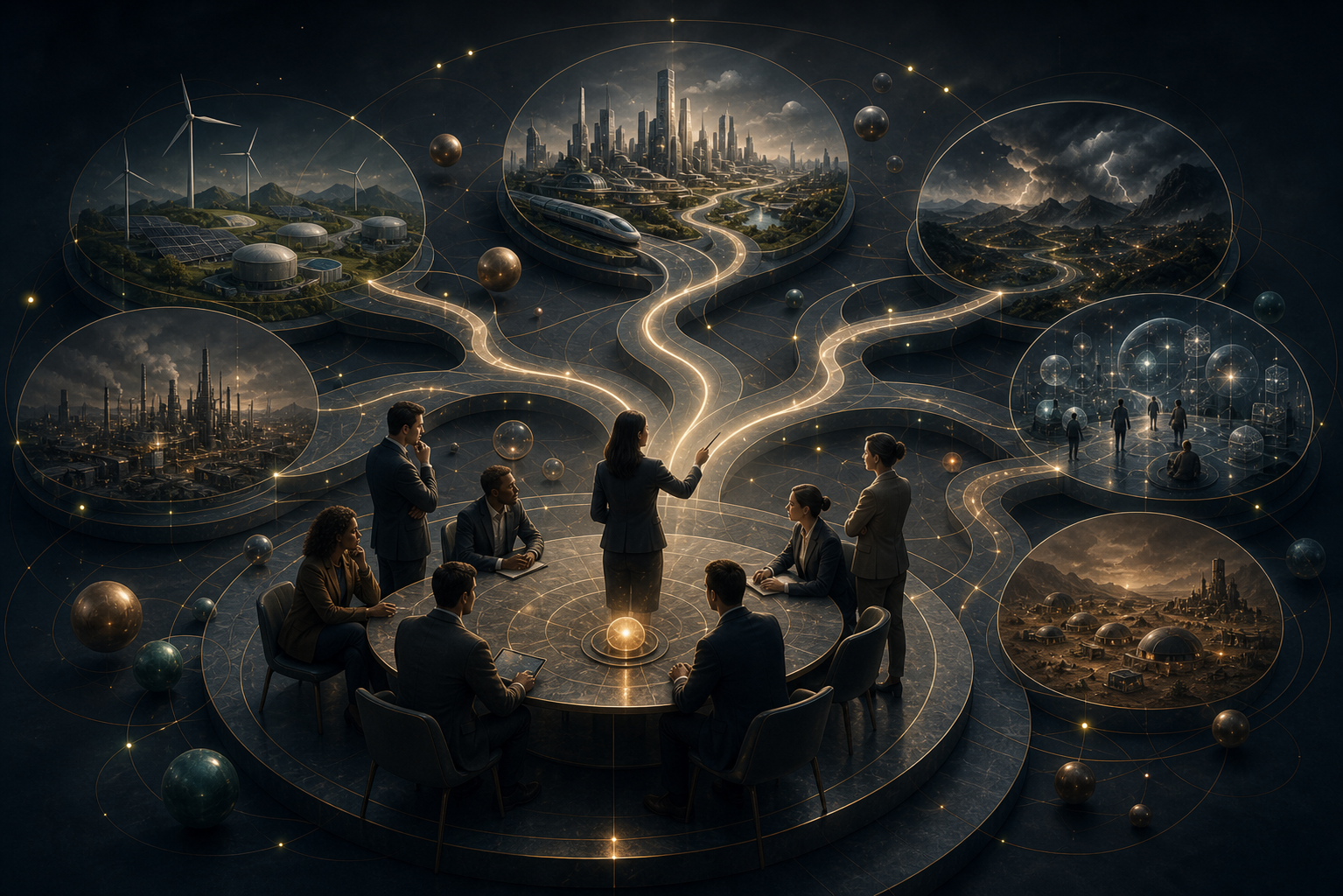
Managers implicitly act against a scenario or mental model that highlights how the world will work into the future.
Scenario planning is a tool in the strategic planning toolkit that creates the possible futures that are increasingly likely to happen. They open up the possibilities of change by creating some possible futures that can be used to guide decision-making. Many businesses often get stuck into a tunnel vision mentality that predicts that everything will be the same today as it was yesterday. Yet the world changes and to understand some of these forces — scenario planning is used to act differently.
Using Scenarios
Scenario planning is not a one size fits all solution so it is best to know when to use them. Scenarios gets used when
-
Too many costly surprises have occurred in the past.
-
The company does not perceive or generate new opportunities.
-
The quality of strategic thinking is low and the organisation becomes too routine oriented and bureaucratic.
-
The industry has experienced significant change or is about to.
-
There are many changes in the scope of the business and their interactions are hard to predict.
-
The company wants a common language and framework, without stifling diversity.
-
There are strong differences of opinion, with multiple opinions having merit.
-
Competitors are using scenario planning.
An organisation with a strong scenario planning discipline may evaluate new initiatives against scenarios and even consider different investment parameters as scenarios change.
Constructing Scenarios
Scenario planning attempts to compensate for our tendency to imagine the future without such a rate of change and to balance against futurists who usually over-predict and present the future like it is going to happen tomorrow.
Scenario planning, then, allows us to chart a middle ground between under- and over prediction. It helps expand the range of possibilities we can see, while keeping us from drifting into science fiction.
Some people use existing scenarios to contextualise it for their own business.
Scenario planning does this by dividing our knowledge into two areas:
(1) Things we believe we know something about and
(2) Elements we consider uncertain or unknowable.
It is not possible to account for all the outcomes of each uncertainty but we need to analyse the tendency of many variables as these indicate the trends that are likely to be more prominent.
It is also important that scenarios depict possible futures but not specific strategies to deal with them.
To develop this view it makes sense to invite outsiders into the process, such as major customers, key suppliers, regulators, consultants, and academics.
The overall purpose is to build a shared framework for strategic thinking that encourages diversity and sharper perceptions about external changes and opportunities.
One process for developing scenarios is outlined below.
1. Define the Scope.
The first step is to set the time frame and scope of analysis (in terms of products, markets, geographic areas, and technologies). Once you have determined an appropriate time frame, ask what types of knowledge would be of greatest value to the organization that far down the road. Timeframes are typically longer but scenario analysis is useful on shorter timeframes as well.
2. Identify the Major Stakeholders.
Who will have an interest in these issues? Whom they will affect? Who could influence them? Stakeholders typically include customers, suppliers, competitors, employees, shareholders, government, and so forth. For scenario planning we need to identify their current roles, interests, and power positions, and ask how they have changed over time and why.
3. Identify Basic Trends.
What political, economic, societal, technological, legal, and industry trends are sure to affect the issues you identified in step one? It may be helpful to list each trend on a chart or so-called influence diagram to identify its impact as positive, negative, or uncertain. Everyone participating in the process must agree that these trends will continue; any trend on which there is disagreement (within the time frame) belongs in the next step.
4. Identify Key Uncertainties.
What events, whose outcomes are uncertain, will significantly affect the issues you are concerned with? Will a particular piece of legislation be passed? Will a new technology be developed? What will consumers value in the future? For each uncertainty, determine possible outcomes. Again, it's best to keep these outcomes simple, with a few possibilities at most.
5. Construct Initial Scenario Themes.
By grouping themes or trend that tend to belong together you can now have build some common scenarios. This process of refinement of ideas that belong together and that have similar drivers that all participants agree is present is really the heart of scenario planning.
6. Check for Consistency and Plausibility.
The results need to be compared against the timeframe. The different elements of a scenario need to support each other and create a story line that makes sense.
Each scenario ideally should describe equilibrium or a state in which the system might exist for some length of time, as opposed to being highly transient. It does an organization little good to prepare for a possible future that will be quite short-lived. In short, the scenarios should cover a wide range of possibilities and highlight competing perspectives (within and outside the firm), while focusing on inter-linkages and the internal logic within each future.
7. Develop Learning Scenarios.
From this process of constructing simple scenarios and checking them for consistency, some general themes should emerge. The initial scenarios provide future boundaries, but they may be implausible, inconsistent, or irrelevant. The goal is to identify themes that are strategically relevant and then organize the possible outcomes and trends around them. Although the trends, by definition, appear in all the scenarios, they can be given more or less weight or attention in different scenarios.
Naming the scenarios is also important. It is also important effectively name scenarios e.g. "Everyone has a digital device" against "Poor cannot afford digital devices". You then describe what happens in relation to these macro trends.
A scenario is a story; by capturing its essence in a title, you make the story easy to follow and remember. At this stage, you have constructed learning scenarios, which are tools for research and study, rather than for decision-making. The titles and themes are focal points around which to develop and test the scenarios.
8. Turn scenarios into models
Scenarios may require additional research to guide the uncertainties that were identified. Also — once the underlying trends are understood they are often developed into quantitative models against which future impacts can be tested.
Conclusion
Scenario planning is an internal discipline whereby we look at likely futures and start putting in place models that allow us to evaluate our business decisions against these. To make them effective the futures that they predict should be plausible and useful for the organisation. By translating these into practical models it can assist in building resilient organisations that transcend the typical cycles of business by preparing and building responses to different market conditions.
Reading Map
Where to go next.
Follow the thread, jump to a fresh signal, or step into the deep archive. These are discovery paths through the body of work rather than claims about readership popularity.
Continue the thread
The nearest essays in the chronology, useful when you want to keep moving with the current line of thought.
Fresh signals
Recent essays from the archive for readers who want the newest edge of the map.
Deep archive
Older, less-travelled essays that deserve another pass through the reader’s hands.
Open another territory
Choose a larger field of inquiry when the current essay opens more than one door.