When Money Circulates but the Economy Remains Dependent
Local spending can support nearby firms while production, essential supplies and the first source of income remain externally dependent.
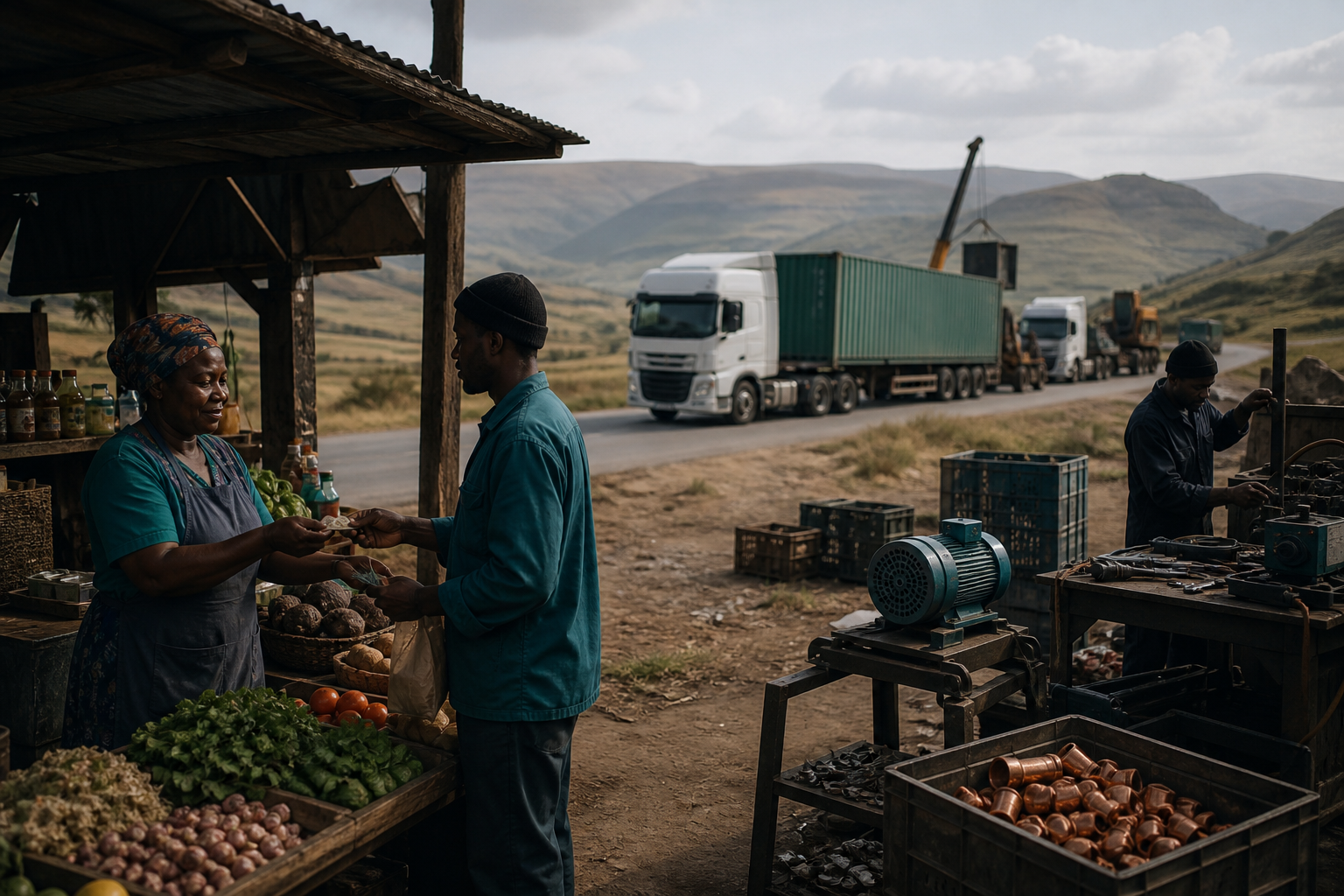
Part 3 of 10 in the 10,000 People Economy series.
A worker earns a local wage and spends it at a local shop.
The shop pays a local delivery service. The delivery service pays a local bookkeeper. The same money has supported several transactions inside the community.
The food came from outside. The delivery vehicle, fuel, payment system and refrigeration equipment came from outside. The worker's medicine came from outside. The first wage may have been funded by an external grant.
The money has circulated locally, but the community is still dependent on outside production, assets and funding. Local circulation matters; it simply cannot carry the whole idea of economic self-sufficiency.
A Local Payment Does Not Prove Local Production
Local-spend campaigns are useful. They can direct demand towards nearby businesses and keep more income in the area.
But the till receipt does not tell us where the product was made, which inputs were imported, who owns the productive assets or whether the local supplier can replace its stock without external cash.
A local retailer selling imported food creates some local value through labour, rent and service. It does not create the same productive capacity as a local food system that grows, processes, stores and distributes the product.
Both transactions matter. They should not be measured as the same thing.
Circularity Is Doing Too Much Work
The word circularity is often used for several different ideas:
- money being spent more than once locally;
- local firms creating value;
- essential products being supplied locally;
- materials being repaired, reused or recovered;
- assets being maintained instead of consumed; and
- the community earning enough outside cash to pay for imports.
These ideas are related, but they answer different questions. The 10,000 People Economy previously treated circularity as one broad objective. I now think that was asking one word to do too much work. The current model separates the dimensions, producing a less dramatic dashboard but a more honest account of the economy.
Five Questions, Not One Score
The first question is monetary: how much household and enterprise spending is captured by local suppliers?
The current planning model reports a final local recirculation ratio of 58.8 per cent. It estimates R680 million in household spending after tax, savings and remittances, with R382.7 million captured locally and R249.4 million leaking to outside household purchases.
This tells us where money is spent. It does not tell us what was produced.
The second question is productive: how much value is created locally after intermediate inputs are deducted?
The model's year-five supply-and-use account reports substantial local value added. This matters because wages and operating surplus are created through production, not merely through resale. But a high-value digital or professional service sector does not feed the community or supply medicine.
The third question is provision: how much of the essential basket can the community supply?
The current planning case supplies 46.4 per cent of costed essential demand locally. Its modelled feasible ceiling is 76.4 per cent. The remainder includes products such as critical medicines, equipment and technical inputs that may be inefficient or unsafe to reproduce inside a 10,000-person boundary.
This is an important correction. The objective is not autarky. It is to know which dependencies can be reduced and which imports should be deliberately funded.
The fourth question is physical: are food, water, energy, maintenance, health inputs and materials actually available in the required units?
Money cannot answer this question on its own. A balanced budget does not create a megawatt-hour, a megalitre of water or a dose of medicine. These systems need physical balances.
The current base scenario reports average local physical coverage of 53.1 per cent. That is below the model's integrated resilience gate, so the result remains RECOVERY PLAN REQUIRED even though the monetary identity balances.
The fifth question is external cash: does the community earn enough unrestricted money from outside after all costs?
Gross exports are not the answer. Customer collections must first pay for imported inputs, logistics, operating costs, tax, working capital, maintenance, replacement, debt service and disaster reserves.
What remains after those claims is the money available to cover the community's wider external needs.
Dependence Is Not the Same as Failure
No sensible 10,000-person community should attempt to produce everything.
It may be more reliable and efficient to import specialist equipment, advanced medicine, complex digital services and some industrial inputs. Economic autonomy does not mean cutting the community off from the rest of South Africa or the world.
It means three things.
First, the community knows what it depends on.
Second, it has chosen which dependencies to reduce because they create unacceptable vulnerability or missed productive opportunity.
Third, it earns enough external cash to pay for the imports it retains.
That is open interdependence. The alternative is dependence funded by transfers, debt or assets that are slowly being consumed.
Import Substitution Has a Cost
The model estimates that removing R114.4 million a year of involuntary dependence would require about R2.410 billion in additional productive capacity.
That is not a small adjustment. It involves assets, facilities, skills, maintenance and finance.
The number is a planning estimate, not an approved investment case. Its value is that it prevents import substitution from being described as free. Producing more locally can improve employment and resilience. It can also absorb scarce capital into activities where the community lacks scale or technical capability.
Every localisation decision should therefore answer:
- What vulnerability does this investment reduce?
- What capability and employment does it create?
- What is the full life-cycle cost?
- Which imports remain in the production process?
- Is external sourcing still safer or more efficient?
The decision cannot be reduced to local good, imported bad. Resilience depends on the design of the production system, the alternatives available and the cost of failure.
The Dashboard Must Refuse the Easy Story
A serious community-economy dashboard should show the five dimensions separately.
It should not allow a rising local-spend ratio to hide falling water or energy security. It should not allow gross export sales to stand in for collected cash. It should not convert tonnes, kilowatt-hours and service encounters into one circularity percentage that nobody can audit.
Each claim also needs an evidence status.
A modelled ratio is not a measured ratio. A submitted invoice is not an independently accepted account. A balanced spreadsheet is not an operating economy.
The current 10,000 People Economy model has balanced planning identities. It does not yet have accepted site evidence for the complete physical, production and external-cash accounts. Its source-gated external cover therefore remains zero.
That is the correct result until the evidence changes.
Circulation Is the Beginning of the Question
Keeping money local can support firms, employment and capability. It is worth doing.
The mistake is to treat circulation as the end of the analysis.
The better questions are what the community produces, what it must import, which physical systems are resilient, whether assets are being renewed and how external obligations are funded.
Money tells us where transactions move. The harder question, and the one the model must answer, is what those transactions can sustain.
Sources
- 10,000 People Economy Project. (2026). Internal Flows Model Specification v1.
- Chertow, M. R. (2000). Industrial symbiosis: Literature and taxonomy. Annual Review of Energy and the Environment, 25, 313-337.
- Geissdoerfer, M. et al. (2017). The circular economy: A new sustainability paradigm? Journal of Cleaner Production, 143, 757-768.
- United Nations et al. (2014). System of Environmental-Economic Accounting 2012: Central Framework.
Previous: A Job List Is Not an Economy
Next: The Customer Comes Before the Job Count
Reading Map
Where to go next.
Follow the thread, jump to a fresh signal, or step into the deep archive. These are discovery paths through the body of work rather than claims about readership popularity.
Continue the thread
The nearest essays in the chronology, useful when you want to keep moving with the current line of thought.
Fresh signals
Recent essays from the archive for readers who want the newest edge of the map.
Deep archive
Older, less-travelled essays that deserve another pass through the reader’s hands.
Open another territory
Choose a larger field of inquiry when the current essay opens more than one door.