When Organisations Become Bureaucracies
There is a delicate time between when a business stops growing and when it becomes a bureaucracy.
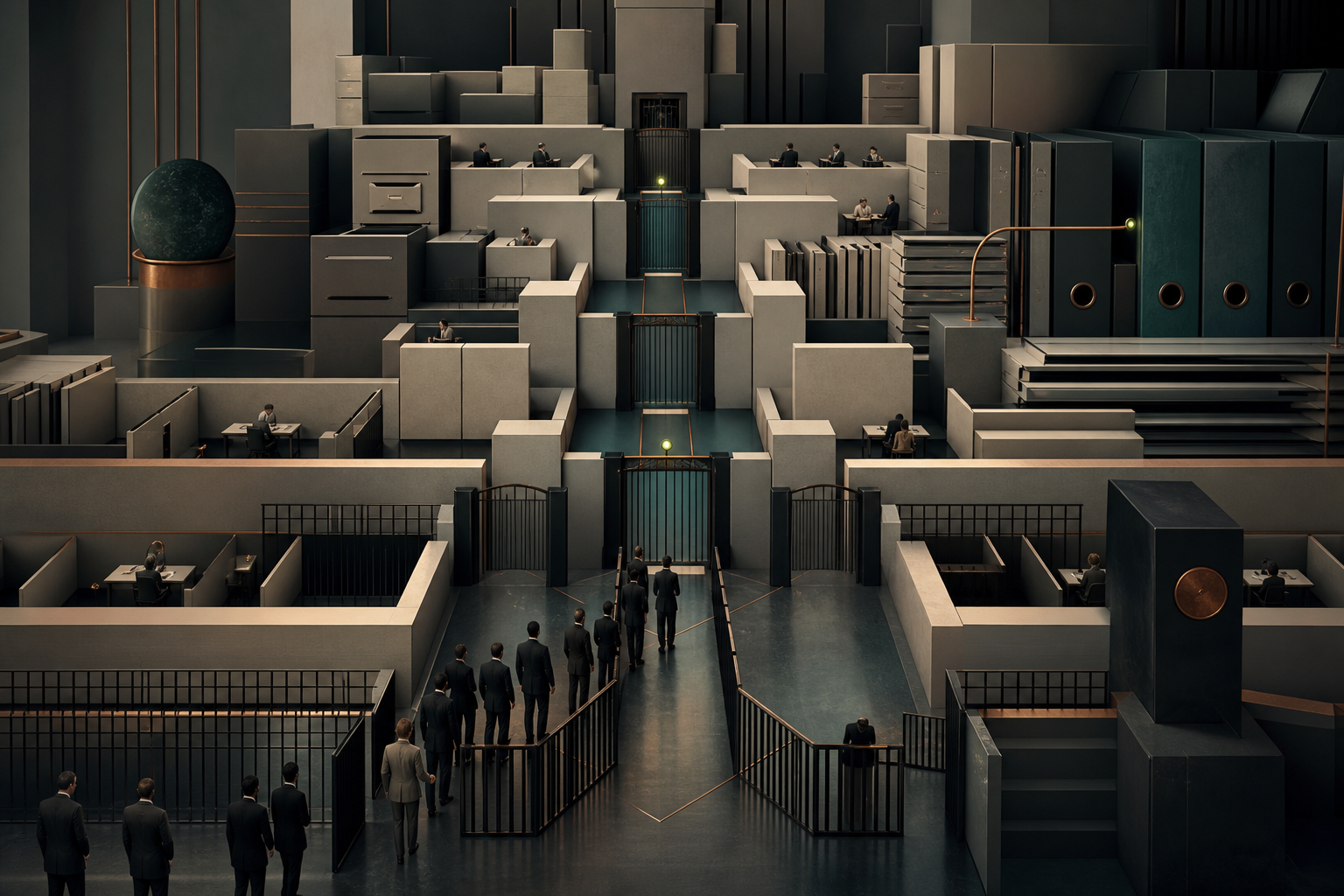
There is a delicate time between when a business stops growing and
when it becomes a bureaucracy.
It does not happen all at once.
At first, the organisation adds structure because it must. More
customers require more people. More people require roles. More roles
require processes. More products require coordination. More risk
requires controls. More scale requires some form of order.
This is normal.
Growth without structure becomes chaos.
But structure becomes bureaucracy when the organisation starts to
organise itself around its departments rather than around its
customers.
The moment we hand a customer off to another department and treat
that handoff as the customer’s problem, we have lost the central
organising principle of a business.
The purpose of a business is to serve the customer.
Not to defend the department.
Not to protect the process.
Not to explain the structure.
Not to make the customer understand how complicated the organisation
has become.
The Customer Sees One
Organisation
Customers do not experience a company the way the company is
organised.
They do not wake up thinking:
Today I will interact with sales, then fulfilment, then billing, then
technical support, then customer care, then retention, then the
complaints department.
They experience one organisation.
They bought from one brand.
They trusted one promise.
They paid one business.
When something goes wrong, they do not care whether the problem sits
in product, service, technology, finance, logistics or compliance. They
care that the organisation they trusted is not solving the problem.
This is the reality of branding.
A brand creates a single identity.
It tells the customer: this is who we are.
It does not say: this is who we are, except when you need support, or
when billing fails, or when the website behaves badly, or when delivery
is delayed, or when one division does not speak to another.
The brand is one.
The service experience must respect that.
The Apple Example
If I buy from Apple, I do not think I am entering a relationship with
Apple’s customer service division.
I think I am dealing with Apple.
If the product fails, the support experience becomes Apple.
If the store is elegant but the support process is painful, the brand
is damaged.
If the device is beautifully designed but the service journey makes
me repeat myself five times, the product experience is no longer
beautiful.
The customer does not separate the company into internal
compartments.
The company may do that.
The customer does not.
This is true for every organisation, not only global technology
brands.
A university is not separate from admissions, finance, academic
support, learning platforms, lecturers, student wellness, timetables and
graduation. To the student, all of these are the university.
A bank is not separate from the app, the branch, the call centre, the
card division, fraud support and home loans. To the customer, all of
these are the bank.
A retailer is not separate from online ordering, delivery, returns,
payment, stock availability and store staff. To the customer, all of
these are the retailer.
The organisation sees functions.
The customer sees identity.
Handoff Is a Moment of Risk
Every handoff is a moment of risk.
When a customer moves from one person to another, information can be
lost. Context can disappear. Responsibility can become unclear. The
customer may be asked to repeat the story. The next person may not have
authority. The system may not show the previous interaction. The
department may apply a different rule.
The organisation calls this escalation, routing, referral or
workflow.
The customer experiences it as friction.
Not all handoffs are bad.
Complex work often requires specialists. A customer may need
technical expertise, financial approval, compliance review, product
support or logistics intervention.
The problem is not the existence of departments.
The problem is when departments become more real than the
customer.
A good handoff protects continuity.
It carries the customer’s story forward. It makes ownership clear. It
explains what will happen next. It prevents repetition. It preserves
urgency. It gives the next person enough context and authority to
act.
A bad handoff makes the customer start again.
That is bureaucracy in action.
Bureaucracy Begins
with Internal Language
One sign of bureaucracy is that employees begin to explain the
organisation to the customer.
That is not our department.
You need to speak to accounts.
Technical support does not handle billing.
The system will not allow us to do that.
You must log a separate ticket.
The product team owns that.
The customer hears something different.
We are organised in a way that matters more than your problem.
This is not always what employees intend.
Often they are trapped inside the structure. They may want to help
but lack authority, system access, information, time, training or
permission.
That is why bureaucracy should not only be blamed on frontline
people.
Frontline people often reveal the design failure.
When they say, “I cannot help you because another department owns
this,” they may be telling the truth.
The management question is whether that truth should be
acceptable.
Products
Create Relationships the Customer Did Not Ask For
Companies often believe every new product creates a new
relationship.
The customer buys product A, then product B, then product C. Each
product has its own team, process, system, communication, support
journey, pricing logic and success measure.
Internally this may make sense.
Each product has owners. Each owner has targets. Each target has
reporting. Each reporting line creates activity.
But the customer does not have time to invest in multiple
relationships with the same company.
They do not want to learn the internal map.
They do not want to discover that one product has excellent support
while another has a different portal, another uses a different account
manager, and another requires a separate escalation route.
They want one relationship with one organisation.
This is the dichotomy that every product and service design decision
must resolve.
The company wants to grow through products.
The customer wants coherence.
The company wants ownership lines.
The customer wants one experience.
The company wants specialised teams.
The customer wants the promise kept.
If this tension is not designed deliberately, the company becomes a
bureaucracy from the customer’s point of view.
Single Experience
Does Not Mean Single Person
A single customer experience does not mean that one person must do
everything.
That is impossible in a complex organisation.
It means that the customer should not have to carry the burden of
integration.
The organisation must integrate itself before it reaches the
customer.
The customer should not have to remember who said what, which
department owns what, which reference number applies, which form belongs
to which product, which portal is current, or which person has authority
to solve the problem.
The organisation should remember.
The system should remember.
The process should remember.
The next person should know enough to continue.
This is what it means to be one organisation in practice.
It is not a brand statement.
It is an operating discipline.
Service Must
Be Designed Across the Whole Journey
Service is often designed in fragments.
Sales designs the sales journey.
Operations designs fulfilment.
Finance designs billing.
Technology designs the platform.
Customer care designs support scripts.
Compliance designs rules.
Marketing designs the promise.
Each fragment may be reasonable.
Together they may still create a poor experience.
The customer journey cuts across the organisation. It does not
respect the structure chart. It moves from expectation to purchase, from
purchase to use, from use to support, from support to renewal, from
renewal to loyalty or exit.
If each department optimises its own fragment, the whole journey can
still fail.
This is why service design must be cross-functional.
Someone must own the whole experience.
Someone must ask what the customer sees, feels, repeats, waits for,
misunderstands, cannot access, cannot resolve and cannot trust.
Without this whole-journey view, the organisation becomes efficient
in parts and ineffective as a whole.
Measures Can Reinforce
Bureaucracy
Internal measures often make bureaucracy worse.
If a call centre is measured on call duration, agents may transfer
quickly instead of resolving deeply.
If departments are measured on their own turnaround time, they may
pass work along before the customer is actually helped.
If product teams are measured on product performance only, they may
ignore the friction their product creates elsewhere.
If sales is measured on acquisition only, it may create expectations
that operations cannot meet.
If support is measured on ticket closure, it may close the ticket
while leaving the customer problem alive.
The measure tells people what the organisation truly values.
If the measure values internal completion more than customer
resolution, bureaucracy will grow.
The better question is:
Did the customer get what they needed from the organisation?
Not from the department.
From the organisation.
Ownership Must Follow the
Customer
In a customer-centred organisation, ownership follows the customer
problem until it is resolved.
This does not mean the first person must solve everything
personally.
It means the customer is not abandoned at the boundary between
departments.
Someone remains accountable for the thread.
The customer knows who is coordinating.
The next step is clear.
The organisation does not force the customer to become the project
manager of its internal complexity.
This is especially important in difficult moments.
When something has gone wrong, the customer is already spending
emotional energy. They are frustrated, uncertain, disappointed or under
pressure. Asking them to navigate the organisation’s internal map adds
insult to the original problem.
Service recovery is not only about fixing the issue.
It is about restoring the sense that the organisation is still
whole.
The Growth Trap
Young businesses often serve customers well because everything is
close.
The founder knows the customer. The product team hears complaints
directly. Sales and operations sit near each other. Problems are solved
by conversation. Everyone still remembers that the customer is the
reason the business exists.
As the organisation grows, distance increases.
Roles specialise. Systems multiply. Policies appear. Departments
form. Managers protect capacity. Reporting lines become more important.
The customer becomes data, then segment, then ticket, then
exception.
This is the growth trap.
The organisation needed structure to grow.
But if it is not careful, the structure slowly replaces the customer
as the organising principle.
The cure is not to return to informality.
The cure is to design structure around the customer.
What Leaders Must Ask
Leaders should regularly ask uncomfortable questions about
bureaucracy.
Where do we make customers repeat themselves?
Where do we hand off without ownership?
Where do our products create separate experiences instead of one
relationship?
Where do our measures reward internal completion rather than customer
resolution?
Where do frontline people lack authority to solve obvious
problems?
Where does the customer need to understand our structure before we
can serve them?
Where does our brand promise exceed our operating design?
Where do we say, “That is not our department,” when the customer
hears, “That is not our problem”?
These questions are not cosmetic.
They go to the core of the business.
If the organisation cannot answer them honestly, bureaucracy has
already taken root.
Conclusion
Organisations become bureaucracies when internal structure becomes
more important than customer experience.
Departments may be necessary.
Processes may be necessary.
Specialists may be necessary.
Controls may be necessary.
But none of them should replace the customer as the central
organising principle.
The customer sees one organisation.
The brand creates one identity.
The service experience must honour that identity at every point.
Customers do not have the time, patience or obligation to maintain
separate relationships with every product, department and support
structure inside a company.
The organisation must do that work for them.
The challenge of service is to make internal complexity invisible
enough that the customer can experience coherence.
Not because the business is simple.
Because the business has taken responsibility for its complexity.
That is the difference between an organisation that serves and a
bureaucracy that explains why it cannot.
Reading Map
Where to go next.
Follow the thread, jump to a fresh signal, or step into the deep archive. These are discovery paths through the body of work rather than claims about readership popularity.
Continue the thread
The nearest essays in the chronology, useful when you want to keep moving with the current line of thought.
Fresh signals
Recent essays from the archive for readers who want the newest edge of the map.
Deep archive
Older, less-travelled essays that deserve another pass through the reader’s hands.
Open another territory
Choose a larger field of inquiry when the current essay opens more than one door.